 |
What's New ? - Home - Kerala Link - Subscribe - Contact us |
| Kathakali King Lear The programme. < 6 of 8 > |
|
What's New ? - Home - Kerala Link - Subscribe - Contact us |
| Kathakali King Lear The programme. < 6 of 8 > |
 |
|
|
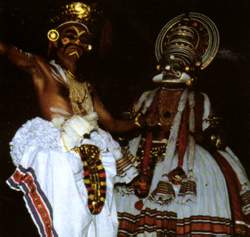
Kathakali is a multi-lingual art form which uses music, poetry, song, make up, costume and dance to tell stories. MAKE UP AND COSTUMES In Kathakali-King Lear, the intensity of Lear's conflict, Cordelia's simplicity and sensitivity and Goneril and Regan's malevolence are written boldly in the elaborate masks of the players. The practical transformation is painstaking and make-up can take up to five hours to apply. Characters are classified by 'types' which correspond to a specific style of make-up and a dominant colour imbued with symbolic value. The more unusual the character, the more abstract and surreal the vesham. King Lear is a Katti, a royal character defined by pride and anger. The basic colours of his make-up are green, to symbolise royalty, and red, to symbolise violence. A 'moustache' is drawn across his face and emphasised by a round white nose. The lines Continue on the forehead above the eyebrows in the form of a knife (katti). The King of France is a Paccha, a royal Character defined by nobility and virtue. The basic colour of his make-up is green (paccha). Goneril and Regan are Karis, extravagant female characters with demonic tendencies. The basic colour of Goneril's makeup is black (kari) and Regan's is dark blue. These colours symbolise the primitive instincts of man. Cordelia is a female Minukku. The Soldier is a male Minukku with an imposing black moustache. These less flamboyant Characters are presented more realistically and the basic colour of their make-up is sparkling orange (minukku). The character of the Fool has no equivalent in Kathakali this adaptation, his make up has been inspired by the Vidushaka a, the King's fool whose role is central to Kutiyattam, the Sanskrit theatre of Kerala. Kutiyattam is the principal literary source of the Kathakali tradition. Tom is a Teppu. His face is painted (teppu) different colours. The keep of this character-type embraces a wide range of roles, from those closely associated to the animal kingdom to those less specifically defined. |
TEXT SONG PERCUSSION Struck with drumsticks or a bare hand, the upright agenda is a light versatile instrument capable of indicating slight movements but also open powerful and echoing. When tuned around, it becomes deeper and more ponderous to accompany ritual or ceremonial moments. The long and heavy maddalam is struck at each end with the fingers. Its sounds are deep, secret vibrant and warm. GESTURE Kathakali gestures are so sophisticated that they amount to an entire language. The actor's hands are his words; his face and eyes are his emotions, and the movements of his body are the punctuation and poetry of his sentences.
DANCE The graceful aspects (lasya) of the dance form are introduced through the delicacy, lightness and discretion of the non-demonic female characters. At times there are moments of pure dance which emphasise certain emotions and events or illustrate specific sequences of action. So, for example, in Kathakali-King Lear the battle scene between the King of France and the two sisters is embodied by martial choreography. |
 |
| Back to main Kathakali page | < 6 of 8 > |